Starting price
$167/mo
Budget tier
Mid-range
Complexity
Advanced
Integrations
120+
Best for
RevOps and growth teams building bespoke, signal-based outbound at scale.
Overview
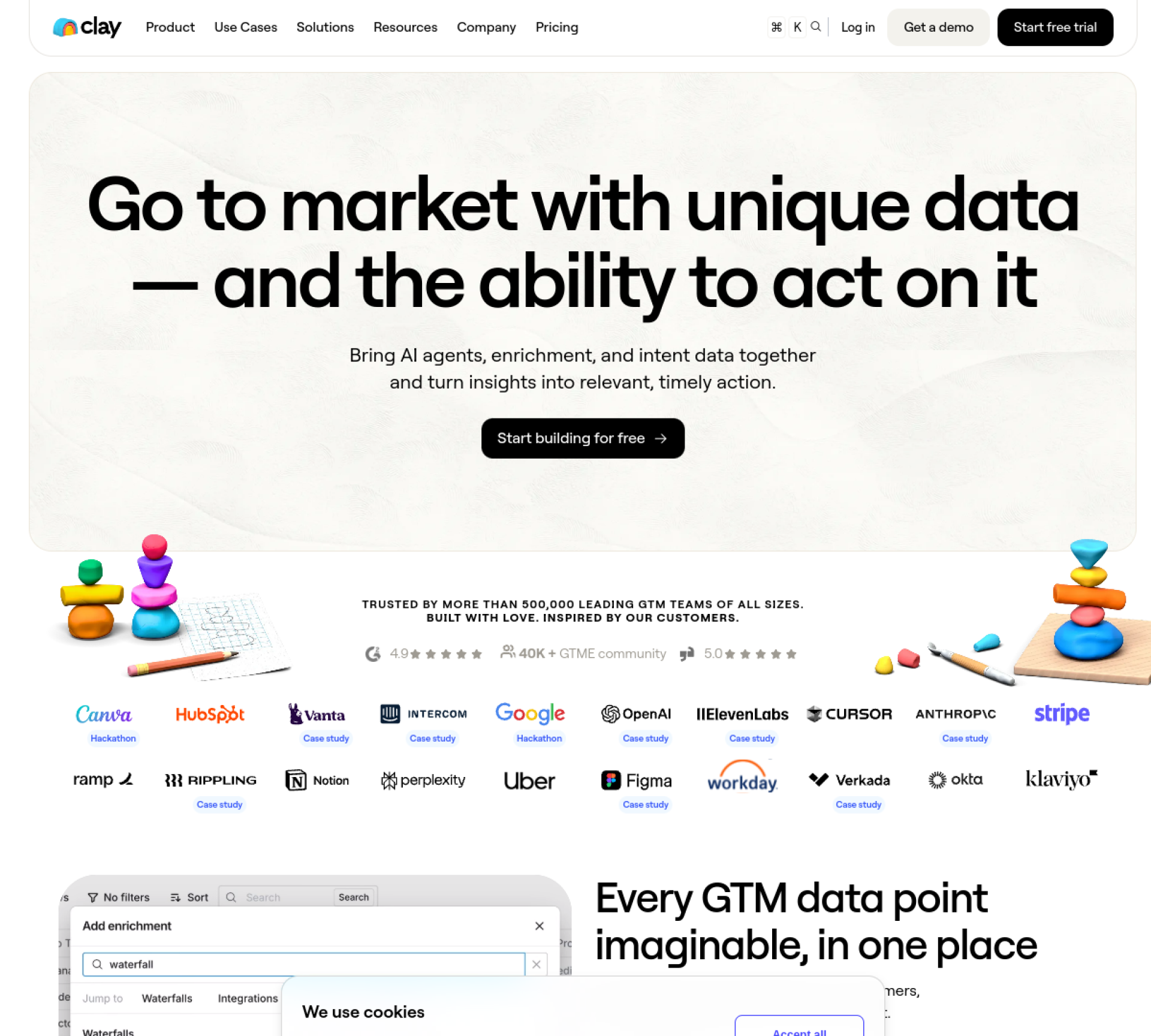
Clay is the power user's prospecting workbench: a spreadsheet that chains 100+ data providers in a waterfall, runs AI research agents, and pushes enriched, scored lists to your sequencer or CRM. Incredibly flexible, with a real learning curve.
Founded in 2017 and based in New York, NY, Clay competes in the sales intelligence & signals category, with overlap into prospecting & lead data. It is powerful, with a steeper learning curve, and it is mid-priced for the value it delivers ($167/mo). In practice, Clay is best for revOps and growth teams building bespoke, signal-based outbound at scale.
Sales intelligence sits one layer above raw contact data, telling reps not just who to contact but who is worth contacting now and why. Teams use it to score accounts against their ICP, watch for triggers like job changes and funding, and arrive at every conversation already briefed. It turns a flat list into a prioritized, timed plan.
Key features
Here is what Clay brings to the table, and what each capability means in practice.
Buyer intent data
Layers buyer-intent signals on top of contacts so you can prioritize accounts that are already researching your category. Reaching out while a company is actively in-market is far more productive than cold-calling a static list.
Account & company research
Compiles firmographics, org charts, tech stack, and recent news so reps walk into an account already prepared. A few minutes of automated research is the difference between a generic pitch and one that lands.
Waterfall data enrichment
Waterfall enrichment queries multiple data sources in sequence to maximize email and phone find rates, paying only for what it returns. Chaining providers reliably beats any single vendor on coverage.
Job-change & hiring signals
Tracks job changes, new hires, funding rounds, and other triggers that signal the right moment to reach out. Timing outreach to a real event consistently outperforms cold contact against a static list.
ICP / lead scoring
Scores and ranks accounts against your ideal-customer profile so reps work the best-fit opportunities first. Pointing limited rep time at the highest-probability accounts is one of the simplest ways to lift win rates.
Workflow automation
Automates repetitive steps, hand-offs, reminders, and field updates with simple rules or visual builders. Every task the system handles is one less thing a rep forgets and one less reason to avoid the CRM.
AI research agents
AI research agents read websites, profiles, and news to answer custom questions about each account at scale. They automate the manual digging that used to eat hours of selling time every week.
CRM enrichment
Continuously enriches, de-duplicates, and refreshes CRM records so data does not rot. Clean data is the foundation everything else, routing, scoring, reporting, quietly depends on.
API & webhooks
An API and webhooks let teams automate workflows and pipe data into their own systems and dashboards. For RevOps teams, this is what makes the tool a building block rather than a silo.
Priority / 24-7 support
Priority or 24/7 support, often with a dedicated contact, is available for teams that cannot afford to wait on a ticket. It matters most once the tool is mission-critical to daily selling.
Who it's for
Clay is built for startups, mid-market teams and enterprises. It is a particularly strong fit for revOps and growth teams building bespoke, signal-based outbound at scale, and reps will find it powerful, with a steeper learning curve.
It is less of a fit in a few cases. Teams that want a plug-and-play tool may prefer something lighter, and if steep learning curve is a dealbreaker for you, it is worth weighing against the alternatives before committing.
Typical users include RevOps and growth teams building signal-based plays, AEs researching accounts before outreach, and marketing teams running account-based programs.
Integrations & ecosystem
Clay connects with around 120+ tools, including HubSpot, Salesforce, Apollo, Smartlead and OpenAI. That matters because a sales tool is only as useful as the rest of your stack: the tighter it plugs into your CRM and workflow, the less manual data entry your reps do and the cleaner your reporting stays.
An open API and webhooks mean Clay can also be wired into custom workflows, internal dashboards, and the rest of your data stack, which is what RevOps teams look for when they want a tool to act as a building block rather than a silo.
Pricing & value
Clay is mid-priced for the value it delivers. Free plan; paid from ~$167/mo billed annually, credit-based. The value case is strongest for the teams it is built for: when that is you, the time saved and meetings booked tend to outweigh the cost. If it is not, a lighter tool may serve you just as well for less. As always, the sticker price is only part of the story: weigh onboarding time, the tier your team will realistically land on, and any add-ons before comparing it against the alternatives.
Strengths & limitations
On the strengths side, Clay stands out for a few reasons: waterfall enrichment across 100+ providers; aI research agents automate account research; and endlessly composable GTM data tool.
The trade-offs are worth knowing before you commit: steep learning curve; credit consumption is hard to predict; and you assemble the workflow yourself. None of these are necessarily dealbreakers, but they are the points to pressure-test during a trial.
The bottom line
Clay delivers waterfall enrichment + AI research in a spreadsheet, and it earns its place across startups, mid-market teams and enterprises. The standout reasons to pick it are clear, waterfall enrichment across 100+ providers chief among them, while the main thing to weigh is that steep learning curve. If that trade-off fits your situation, Clay is well worth a trial.
Pros & cons at a glance
Pros
- Waterfall enrichment across 100+ providers
- AI research agents automate account research
- Endlessly composable GTM data tool
Cons
- Steep learning curve
- Credit consumption is hard to predict
- You assemble the workflow yourself
Features at a glance
Pricing
$167/mo
Free plan; paid from ~$167/mo billed annually, credit-based
Pricing verified against the vendor's site in 2026.
Frequently asked questions
How much does Clay cost? +
Clay starts at $167/mo. Free plan; paid from ~$167/mo billed annually, credit-based.
Does Clay have a free plan? +
Clay does not offer a permanent free plan, though its pricing (free plan; paid from ~$167/mo billed annually, credit-based) often includes a trial to evaluate it first.
What is Clay best for? +
Clay is best for revOps and growth teams building bespoke, signal-based outbound at scale. It is a particularly strong fit for startups, mid-market teams and enterprises, and reps will find it advanced to adopt.
What does Clay integrate with? +
Clay integrates with around 120+ tools, including HubSpot, Salesforce, Apollo, Smartlead and OpenAI.
What are the best Clay alternatives? +
Leading alternatives to Clay include Surfe, FullEnrich and Hublead. You can see the full list, compared side by side, on our Clay alternatives page. See alternatives →
Similar tools
Surfe
Sync LinkedIn to your CRM in one click
Free plan
FullEnrich
Waterfall enrichment across 15+ vendors
$29/mo
Hublead
LinkedIn-to-HubSpot sync & enrichment
$32/mo
Clay in our articles
Guides and comparisons on TheSharkStack that feature Clay.
- Guide
The 5 Best Apollo Alternatives for 2026
Jun 2026 - Guide
The 5 Best Clay Alternatives for 2026
Jun 2026 - Comparison
Clay vs Apollo: Which Prospecting & Enrichment Tool? (2026)
Jun 2026 - Guide
The 5 Best ZoomInfo Alternatives for 2026
Jun 2026 - Comparison
Best waterfall enrichment tools for B2B data (2026)
Jun 2026 - Comparison
Best B2B prospecting & lead data tools (2026)
Jun 2026 - Guide
How to build a modern B2B sales stack (without overspending)
Jun 2026